- Email salesman8@yctshirt.cn
- TEL/WECHAT +86-15876493800
- WhatsApp +86-15876493800
- Email salesman8@yctshirt.cn
- TEL/WECHAT +86-15876493800
- WhatsApp +86-15876493800
Maternity Activewear, Made to Order
Maternity activewear is the range our yoga lines get asked to extend most often, and it is an extension rather than a restart: the fabric book, the production lines and the inspection regime are the ones a brand’s regular leggings and bras already run on. This page is written for founders and sourcing managers planning a maternity capsule — leggings, support tops and cover pieces — either as a stand-alone drop or as the next step in a programme we already cut and sew for you.
What follows is the practical version: what changes in the pattern when a programme goes maternity and what stays exactly as it is, the four garments most first programmes are built from, how the fabric blends are chosen, how the waistband decision gets made, and how sampling, sizing and the order itself run. For the counting rules behind the minimum — per style, per colour — read how a 100-piece order runs start to finish.
100pieces per style, per colour
200pieces for bonded and seam-sealed
3–7days to the first fit sample
15–25days for bulk, from approval
What changes when a programme goes maternity
Most of what changes is in the pattern, not the factory. The body block is re-cut to carry a bump through the waist, hip and rise; the waistband is rebuilt as over-bump or under-bump; the side panels are given adjustable shaping; and bra tops pick up the details a maternity brief calls for — removable pads, a firmer underband, or nursing access where the brief asks for it. Those four changes are pattern and sample work, settled on the fit sample before anything is cut in bulk.
What does not change is the list buyers usually worry about. The fabric system is the same three blends set out below. The garments run on the same lines as the rest of a yoga programme, cut and sewn by the same teams. And quality control is unchanged: every piece passes the same in-line and final checks as a standard legging, held to the same spec card. A maternity piece is not a different product to make — it is a different pattern to get right.
The garments maternity programmes start with
Four silhouettes carry most first maternity programmes, and each one starts from a block that already exists on our floor:
- Maternity leggings. The opening style for most programmes. Cut from the same interlock legging block as our full-length styles, with the rise lengthened and the waistband rebuilt as over-bump or under-bump.
- Support tanks and padded tops. Built on our tank and low-support bra blocks, with removable pads, a firmer underband or nursing access added to the brief where required.
- Side-panel adjustables. Leggings and trousers with adjustable side seams that take in or let out through the waistline, so one size set carries a changing shape and stays wearable after delivery as well as before it.
- Cover pieces. Loose tanks, wrap tops and overlay jackets in the same blends, cut for layering over the support pieces — the styling layer that pulls a lookbook together.
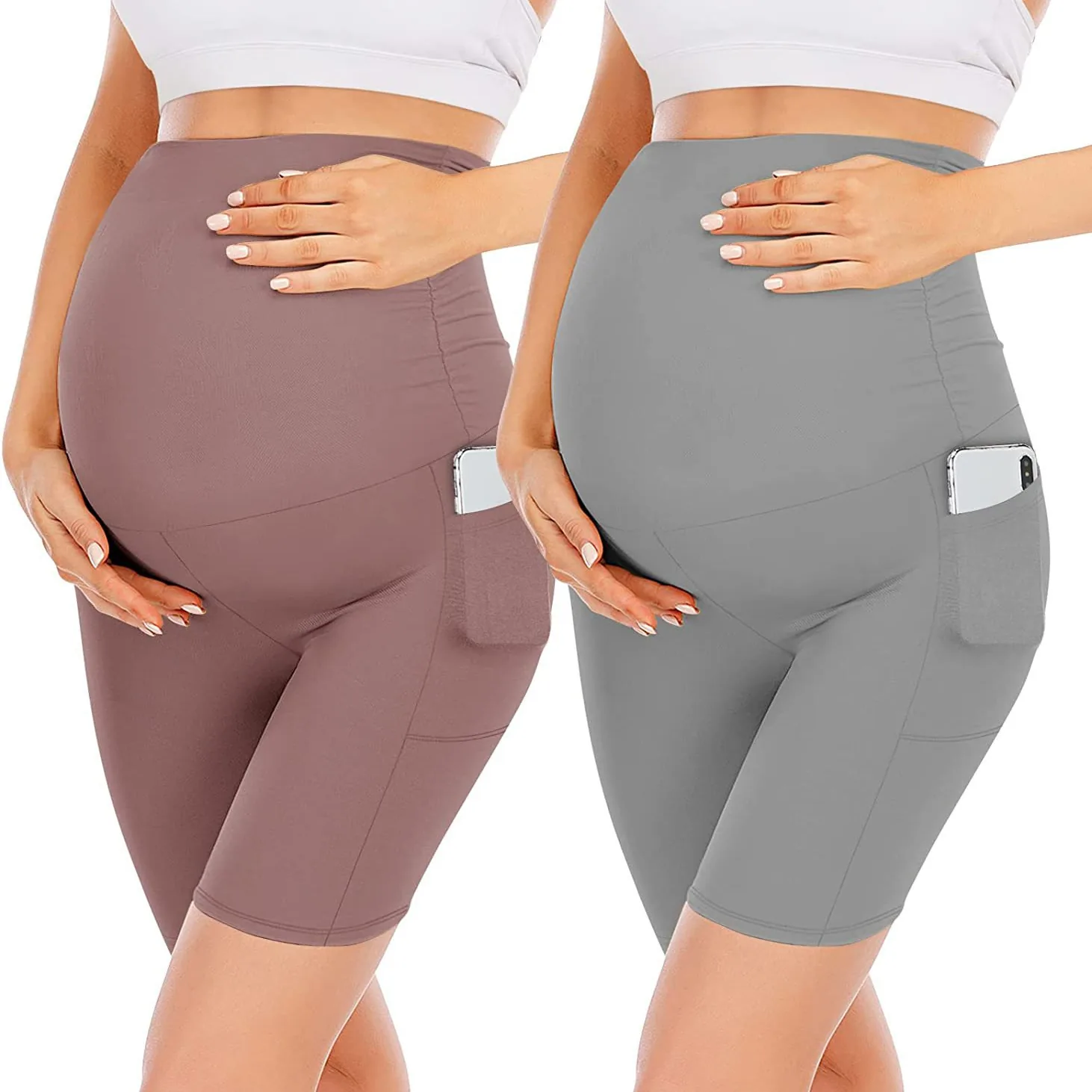
None of these four needs a pattern from zero. Every one is an existing yoga block with maternity grades and features added, which is how a first maternity capsule moves from tech pack to sampling in the same window as a standard programme.
Fabrics: the same three blends, chosen for skin and stretch
The fabric decision is the same one made for any programme on our yoga lines, and the maternity range does not get a separate book.
- Nylon / spandex. The softest hand feel of the three and the best opacity at a given weight — full-length leggings run 220–260 GSM. For pieces worn against skin from morning to night, this is the blend most maternity programmes settle on.
- Polyester / spandex. Dries faster, costs less and takes sublimation printing, at roughly 230–240 GSM to reach comparable opacity.
- Recycled polyester / spandex. The same workhorse performance with a recycled-content claim, and GRS documentation arranged to your order.
For a maternity range, three properties get weighted harder than in a standard brief. Softness, since these pieces sit against skin for longer stretches of the day than a one-hour class. Recovery, since waistband panels and side seams stretch and return through a whole pregnancy — stretch is measured at 30%, 50% and 80% extension and the readings go on the spec card. And opacity, tested in the lightest colourway first, at full stretch, colourway by colourway. Bulk fabric is held to the approved sample within ±5%, and a roll that drifts further is flagged before cutting, not after. If you are weighing weight against garment type before the brief is written, the fabric GSM calculator puts the two side by side.
Over-bump or under-bump: how the waistband decision is made
Over-bump or under-bump is a design decision that belongs to the brand, and we make both. An over-bump band rides up over the curve and stays there: full coverage through a forward fold, no band edge sitting across the bump, and a smooth line under a fitted top — at the cost of more fabric and a higher anchor point on the body. An under-bump band sits below the curve, leaves the bump uncovered, runs cooler, and carries the garment from the hips the way a standard waistband does. Buyers read the difference as coverage versus a lighter, closer feel.
Neither is a house standard, and there is no default band height, width or construction on file. Those numbers are set per style in the tech pack, built on the fit sample, and revised from measured comments. Programmes that cannot decide often run one of each across the range and let their own size guide explain the difference. The band that reaches bulk is the band on the approved sample — nothing about it changes between sampling and production.
Sizing: maternity is a size set, not a separate MOQ
Maternity sizes are a size set inside the same graded block as the main range — the same relationship plus, petite and tall sizes have to a standard block. A legging offered in S–XL plus M–XL maternity is one style with an extended size set, not two products: the maternity grades are drafted from the block with waistband tension and rise adjusted at each size, so the fit holds through the top of the range. The minimum does not move — the style still starts at 100 pieces per colour, sizes mixed freely.
The grading work behind extended size sets is covered on our plus-size grading and fit page, and if you sell into several regions, the clothing size conversion tables set US, EU and Asian charts against each other.
Sampling and fit
A maternity programme samples on the same clock as everything else we cut. The first fit sample takes 3–7 days from an agreed tech pack, made in your target fabric, and it arrives with a measured spec card — GSM, stretch, recovery and colourfastness readings. The sampling stage includes a wash test, so the shrinkage figure on the card is a washed figure, not an estimate.
Fit comments are applied to one numbered version of the record, so revisions never lose the thread. Maternity fit is checked in more places than a standard garment: waistband height across the front, side-seam shaping, rise through the seat, and the underband on tops, all written onto the same card. The pre-production sample is then measured against the fit sample you sealed before bulk starts. The short version of this calendar sits on our answer to how long samples take.
The sampling charge is quoted per style, confirmed in writing before sampling, and credited against your first order at 300 pcs per style. The number moves with the pattern work and construction a style needs, not with the size of the order behind it.
How an order runs
Commercially, a maternity programme runs exactly like any other knit programme on our floor. The minimum is 100 pieces per style per colour, with sizes mixed freely. Bonded and seam-sealed builds start at 200 pieces — what bonded seamless construction involves is set out on the construction page — and the full table of minimums sits on the SLSPOLO MOQ answer.
From sample approval, bulk runs 15–25 days. Every piece passes 100% inspection — in-line checks at each stage and a final check against the graded spec, accepted to AQL 2.5 — then folding, bagging and carton marking to your requirement, before the cartons close. Payment is T/T with a deposit and the balance before shipment, or L/C at sight for full-container orders; quoted EXW, FOB Shenzhen Yantian or DDP.
On price we publish no numbers on this page: indicative FOB ranges for the underlying styles sit in the price tables on our yoga wear page, and a rebuilt waistband or a nursing feature moves the quote, so the figure you get is costed per style from your tech pack.
Questions buyers ask
What is the MOQ for maternity activewear?
It is the same minimum as the rest of our knit range: 100 pcs per style per colour for cut-and-sew, and 200 pcs per style per colour where the style uses bonded or seam-sealed construction. Maternity does not carry its own number — a maternity legging is a legging with an extended size set, counted like any other style. Sizes mix freely inside the style, so one colourway can carry a full graded maternity run.
How long do maternity samples take?
3–7 days for the first fit sample, on the same schedule as our standard programmes. The sample comes in your target fabric with a measured spec card, and the sampling stage includes a wash test, so the shrinkage and recovery figures are washed readings. Every set of fit comments is applied to one numbered version of the record, so nothing is lost between revisions. Where the brief adds nursing access or a new waistband build, the pattern work sits ahead of that window and is scheduled with you at the quoting stage.
Which fabrics do you use for maternity pieces?
The same three blends the rest of a yoga programme runs on. Nylon-spandex, 220–260 GSM for leggings, for the softest hand feel and the best opacity per gram. Polyester-spandex, around 230–240 GSM, where faster drying or sublimation printing matters. Recycled polyester-spandex where the programme needs a recycled-content claim, with GRS documentation arranged to your order. For a maternity range we weight softness and recovery more heavily and check the lightest colourway for opacity first, but the blends and the GSM bands are the standard ones.
Do maternity sizes need a separate order?
No. Maternity is a size set inside the same style, in the same way plus, petite and tall sizes are. The block is graded with waistband tension and rise adjusted at each size, and the pieces are counted inside the style’s minimum like any other size. A brand offering a legging in S–XL and M–XL maternity is running one style with an extended size set, at the same 100 pieces per style per colour.
Do you make over-bump and under-bump waistbands?
Both, and the choice is yours rather than ours. No band height, width or construction is preset on our side: each waistband is specified in your tech pack, built on the fit sample, then revised against measured comments. Over-bump gives full coverage and a band that stays put through movement; under-bump sits below the curve, runs cooler and carries the garment from the hips. Many programmes run one of each across the range.
How is quality controlled on maternity orders?
The same way it is on every order from our floor: 100% inspection with in-line checks at each stage, and a final check against the graded spec accepted to AQL 2.5, with the report sent with the order. Stretch recovery is measured at 30%, 50% and 80% extension, the lightest colourway is checked for opacity at full stretch, and bulk fabric is checked against the approved sample to within ±5%. Test readings and inspection records go out with the shipment.
Next step
Send the tech pack — a sketch, a measurement sheet or a reference garment is enough to start — with the styles, the colour count and the size spread you have in mind, and the reply comes back with fabric options, an itemised quote and a sampling date. One production manager owns the programme from first file to shipment. Contact SLSPOLO to start.