
Scan the WeChat code to contact us
Scan the WeChat code to contact us
Last updated: 17 October 2026 · Written and photographed on our own production floor
SLSPOLO is a custom T-shirt manufacturer in Dongguan, China. We cut and sew OEM, ODM and private label T-shirts — blank basics, printed and embroidered tees, oversized and boxy streetwear blocks, performance sports shirts — for brand owners, streetwear labels, promotional and uniform buyers, from 50 pieces per style per colour. This page shows the whole thing: everything that happens between your first sketch and the container leaving our floor.
The photo series below was shot on our own floor during T-shirt and light-knit runs. A T-shirt shares the knitting, cutting, sewing and packing line with our fleece programme, but it is a different garment where it counts — far lighter fabrics, a much bigger share of printed decoration, and its own neck and side-seam construction. Those differences are the focus of this page. Click any picture to enlarge it.
| Company | SLSPOLO — a knitting and cut-and-sew factory in Humen, Dongguan, Guangdong, China. We are a factory, not a trading company. |
|---|---|
| What we make | Custom T-shirts — crew neck, V-neck, oversized, long sleeve, henley, pocket and performance tees — OEM, ODM and private label. |
| MOQ | 50 pcs per style per colour (semi-custom on stock blanks) · 220 pcs per style per colour (full custom) |
| Sampling | 3–7 working days from confirmed design |
| Bulk lead time | 15–25 days after sample approval and deposit |
| Fabrics | 140–260 GSM — combed ring-spun, carded, CVC, tri-blend and performance poly jersey; interlock and rib on request |
| Decoration | Screen print (plastisol, water-based, discharge, puff), DTG, DTF, sublimation on poly, flat and 3D embroidery, heat transfer |
| Quality | ISO 9001 documented system · in-line checks · AQL 2.5 final inspection against a sealed reference sample |
| Capacity | 18,000+ m² across Dongguan and Hunan · 4 production lines · 180+ workers · 150,000–200,000 pcs per month |
| Contact | salesman8@yctshirt.cn · WhatsApp +86 158 7649 3800 · 5th Floor, No.31 Jianshe Road, Daning Community, Humen Town, Dongguan, Guangdong 523900, China |
Every style below can be produced semi-custom — our stock blank in a stock colour, carrying your branding — or fully custom, from your own fabric, colour, fit, trims and packaging.
| Style | Typical GSM | Semi-custom MOQ | Full custom MOQ |
|---|---|---|---|
| Classic crew neck T-shirt | 140–260 | 50 pcs | 220 pcs |
| V-neck T-shirt | 140–200 | 50 pcs | 220 pcs |
| Oversized / boxy tee, dropped shoulder | 220–260 | 50 pcs | 220 pcs |
| Long-sleeve T-shirt | 160–240 | 50 pcs | 220 pcs |
| Pocket tee | 160–220 | 50 pcs | 220 pcs |
| Henley — button placket, no collar | 180–240 | 50 pcs | 220 pcs |
| Performance / sports tee — polyester or CVC, moisture-wicking | 140–180 | 50 pcs | 220 pcs |
| All-over sublimation tee — poly rich | 140–180 | 50 pcs | 220 pcs |
MOQ is counted per style, per colour. Sizes can be mixed inside one style, so a 50-piece order can cover XS to 3XL. Styles cannot be combined to reach the minimum — each one needs its own marker, its own thread set-up and its own line changeover.
With T-shirts, weight and yarn decide everything — how the tee drapes, how it prints, whether it twists in the wash. We hold and source from 140 to 260 GSM across six fabric families, and we will say so plainly when a weight is wrong for the garment you are describing.
| Fabric | GSM range | Hand feel | Best for |
|---|---|---|---|
| Combed ring-spun cotton jersey | 160–220 | Fine, smooth, clean print surface | Premium retail tees, detailed prints |
| Carded open-end jersey | 160–200 | Softer body, slightly fuzzier surface | Promotional and event runs on a budget |
| CVC 60/40 cotton-poly jersey | 160–220 | Cotton hand, better shape retention | Uniform and promotional programmes |
| Tri-blend — cotton/poly/rayon | 130–160 | Ultra-soft, drapey, heathered look | DTC fashion tees that feel expensive |
| 100% polyester performance / interlock | 140–180 | Smooth, quick-drying, wicking | Sports tees, all-over sublimation |
| Slub / mélange jersey | 160–200 | Textured, irregular surface | Fashion and streetwear blocks |
As a working guide: 140–160 for hot climates and drapey fashion fits; 180–200 for the standard retail tee that most brands sell; 220–260 when the tee has to hold an oversized or boxy silhouette and can be sold as heavyweight streetwear. The same GSM feels different across yarn counts and knits, so we send swatches at two weights before you commit.
You do not need a finished tech pack to start. Send any one of the four below and our pattern team turns it into a confirmed sketch, a size chart and a measurement spec both sides sign before anything is cut.
Everything agreed at this stage — style details, neck finish, size chart, target GSM and the decoration plan — is written into the order file, so the fabric you approve in step 02 is chosen against a fixed brief, not a moving one.
We prepare 2–4 fabric options and courier actual swatches to you — for T-shirts we always include two weights so you can feel the difference GSM makes before deciding. Nothing moves forward until three things are signed:
Every new lot is wash-tested before approval and the measured shrinkage is fed into the pattern as an allowance; the bulk fabric itself is steam pre-shrunk before cutting (step 04). Your size chart is what the garment measures after washing, not before — that is the number your customers will actually check.
Sampling is where the details get locked — normally in two rounds of consultation, with every trim matched before the first sample is sewn.
The first is couriered to you for approval. The second stays with us as the sealed reference standard — the sample your bulk is measured against at inspection. If a bulk garment deviates from it outside the agreed tolerances, it is remade at our cost. That is why sample approval is not a formality.
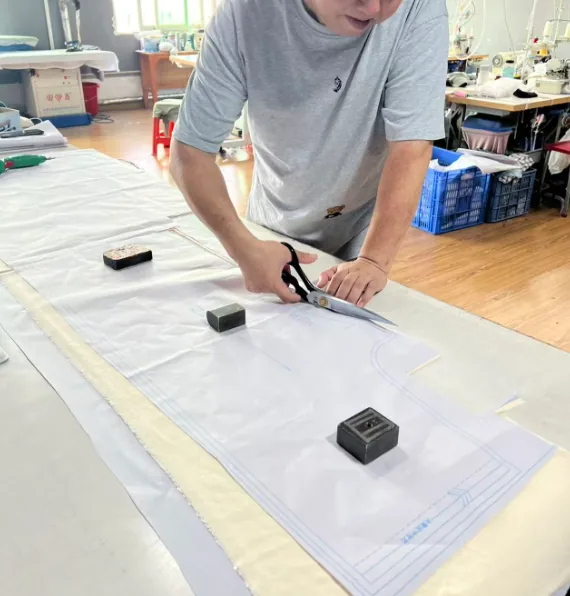
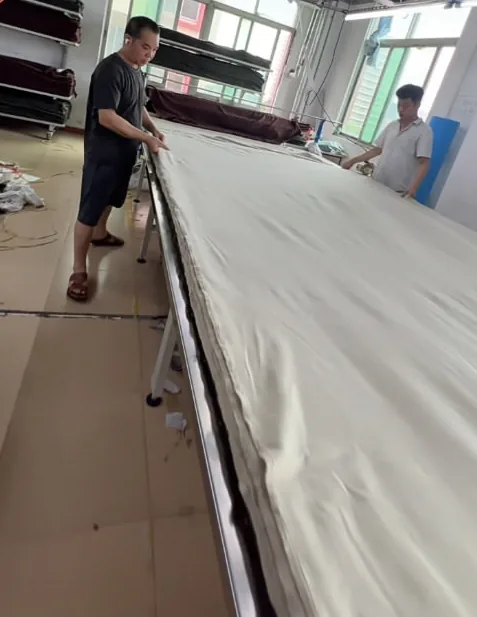
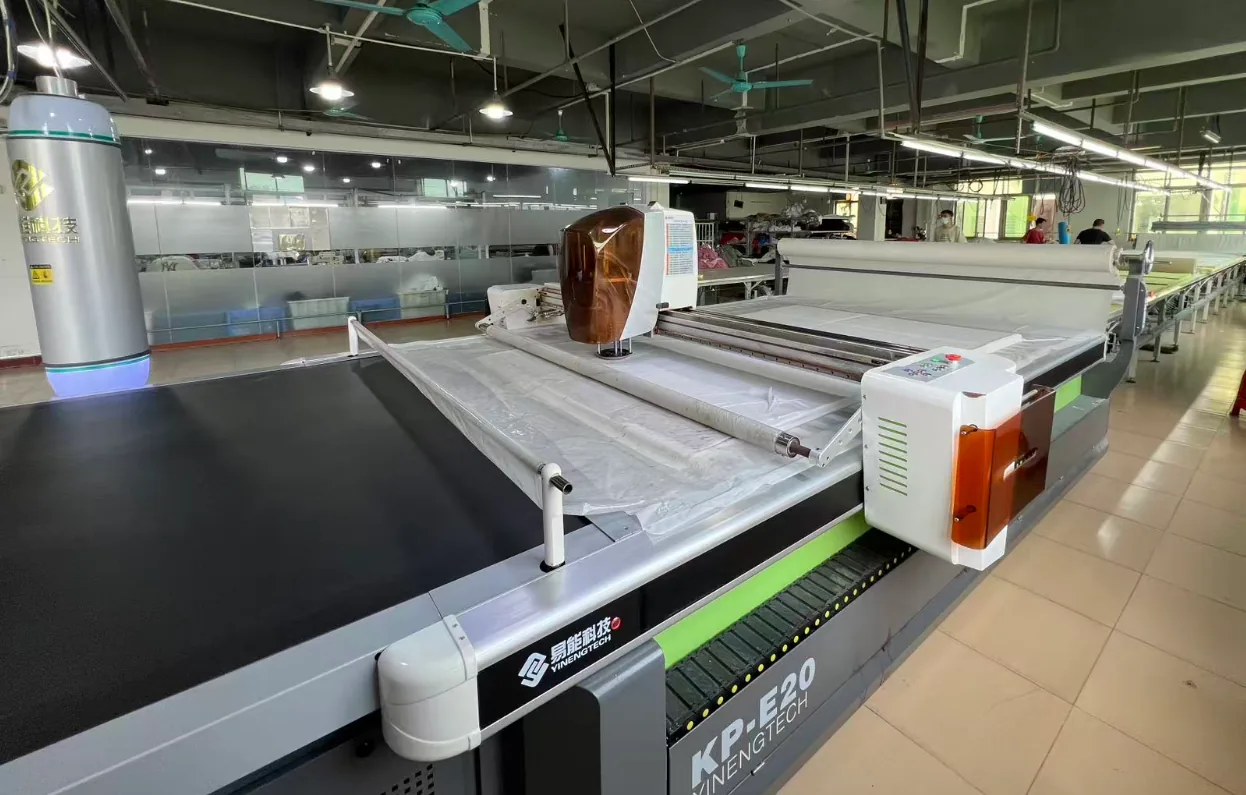
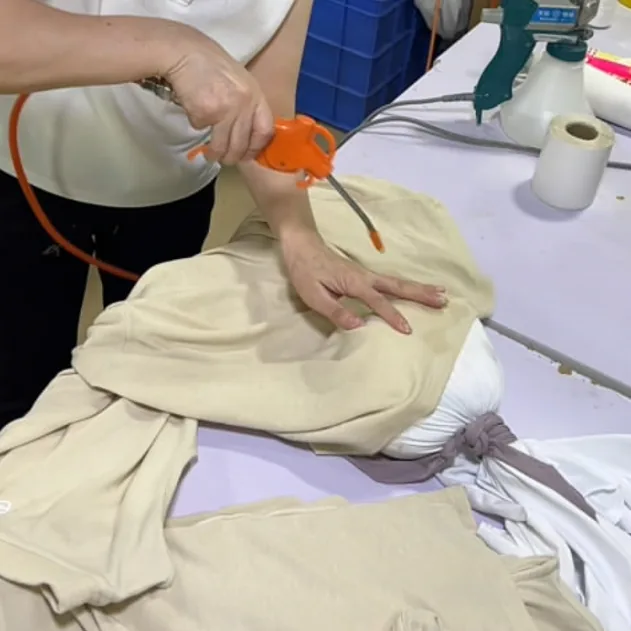
Before a single bulk panel is cut, every order goes through the same routine: spread open and relaxed for 24 hours, then pre-shrunk with high-temperature steam, then laid in plies and cut on our computerized cutting machine.
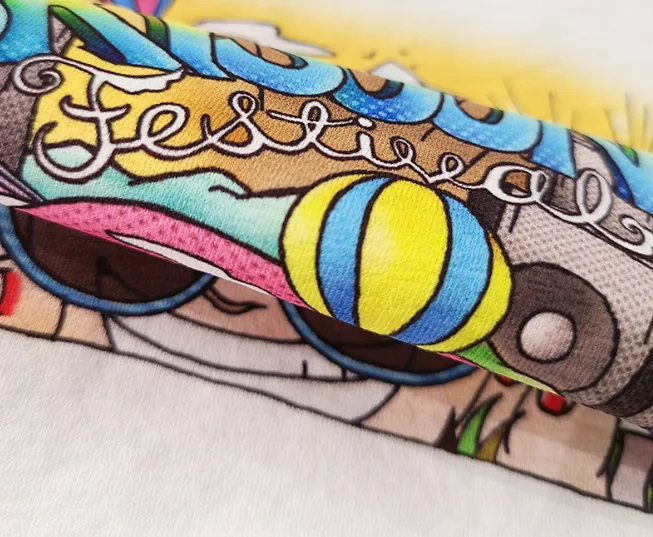
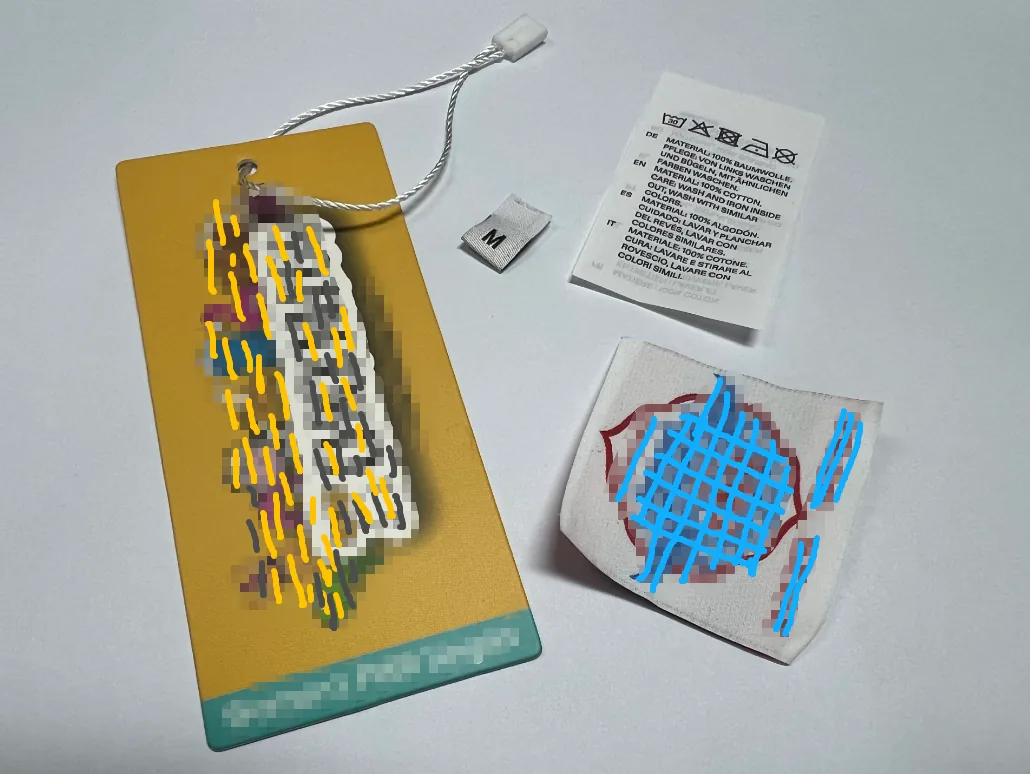
Decoration happens at the cut-piece stage, while the panels are still flat — placement follows a template made off the confirmed pattern instead of an eyeball estimate. On a T-shirt programme this step carries more of the value than on any other garment we make, so it is controlled hardest:
A print that drifts 1 cm across 3,000 pieces is a full rejection. Decorating flat panels removes that variable at the cheapest possible moment — before assembly, when a misprint costs one panel instead of one garment.
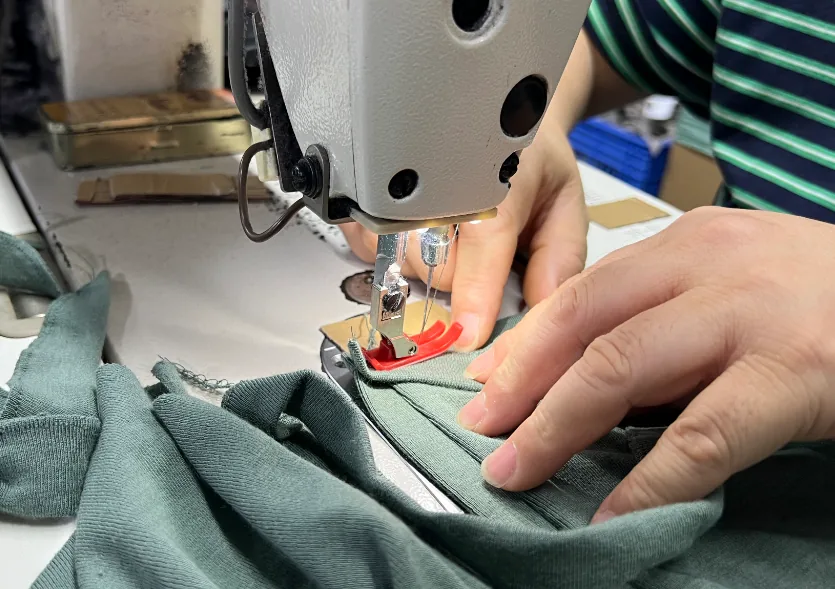
A T-shirt is the simplest garment on our floor, and that is exactly why the four details below separate a tee that survives a season from one that twists and gapes after five washes. All four are standard on our lines:
Assembly runs in a line, each operator repeating one operation, with the production order (step 09) clipped at every workstation.
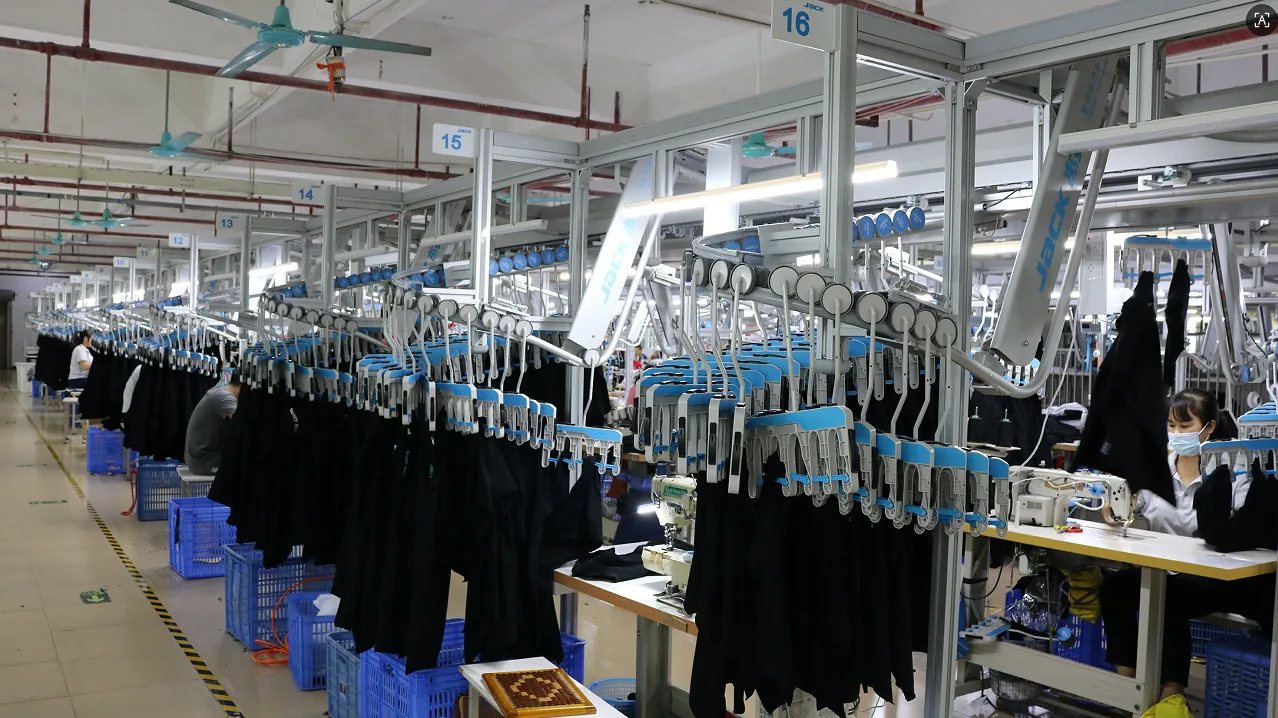
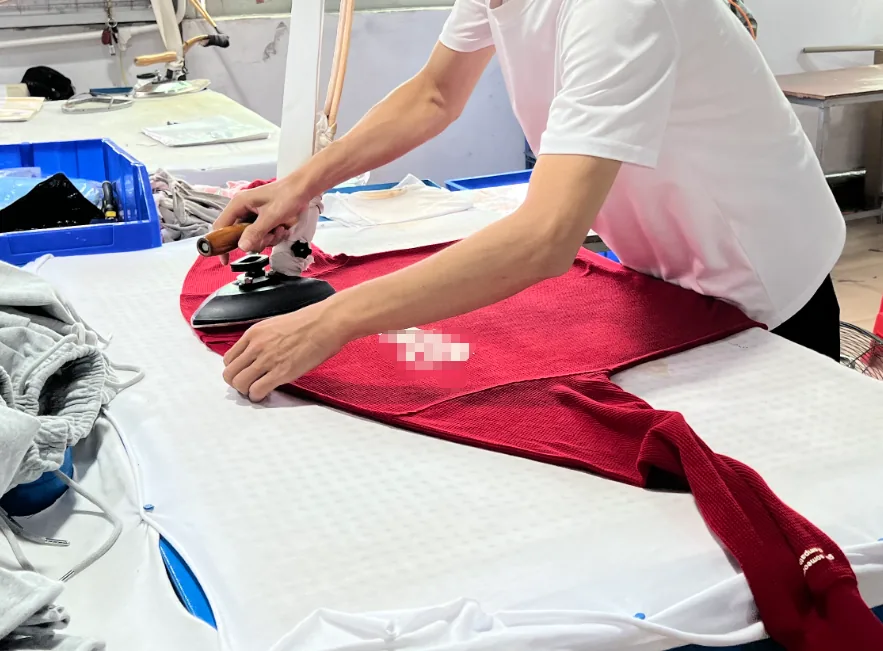
Finished garments go to the finishing department, where four checks run on every piece, followed by AQL 2.5 sampling against the sealed sample.
Inspection sampling follows AQL 2.5 for major defects. The signed sample from step 03 sits on the inspection table as the reference — the bulk is judged against it, not against memory.
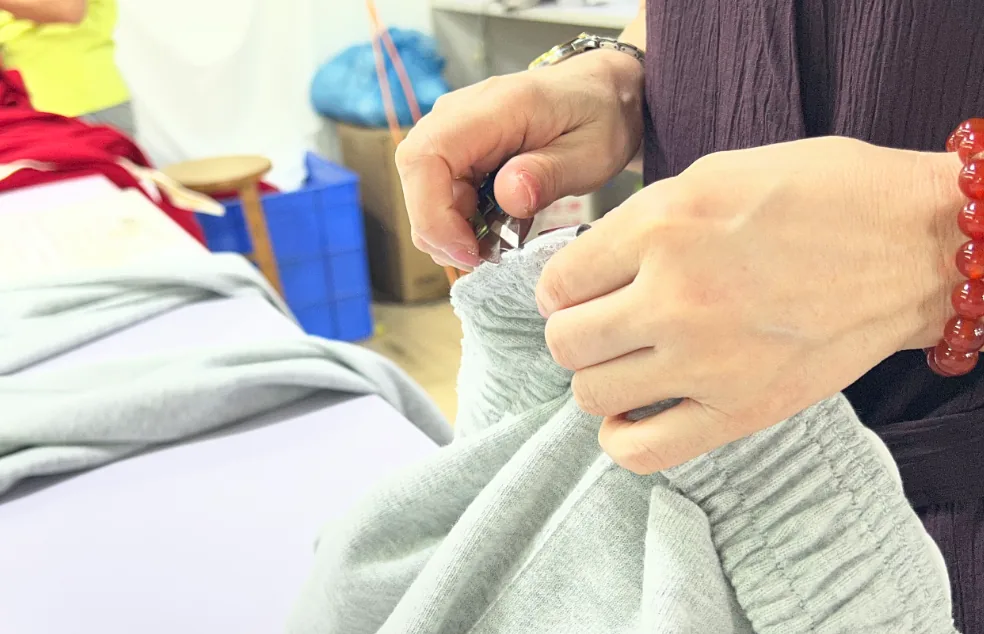
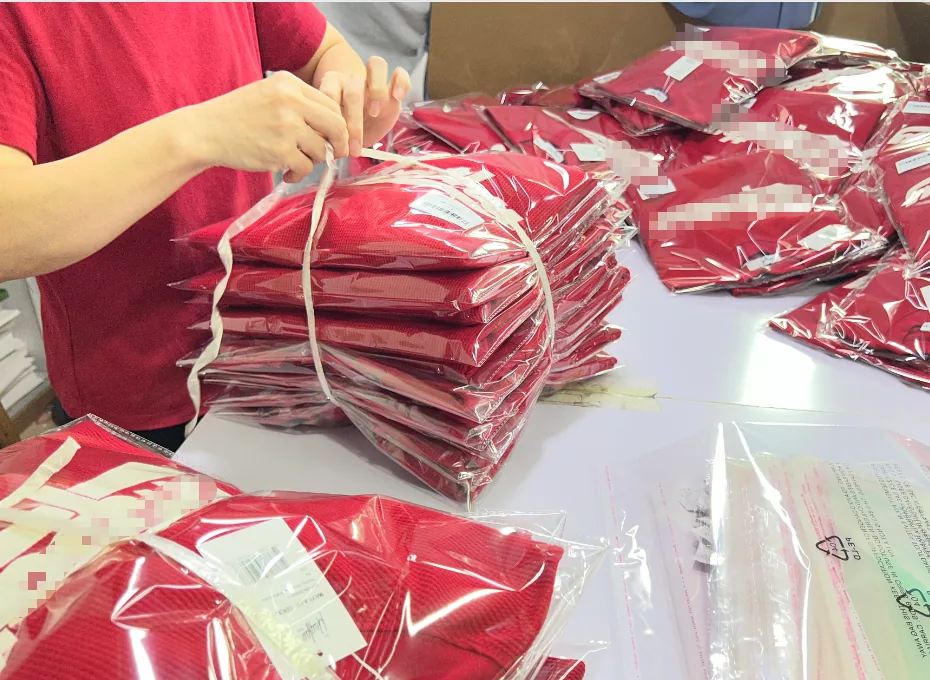
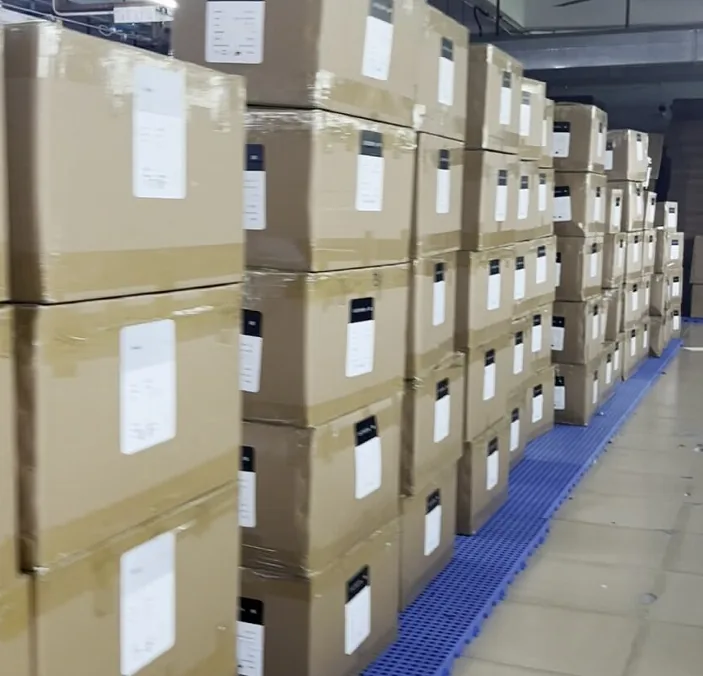
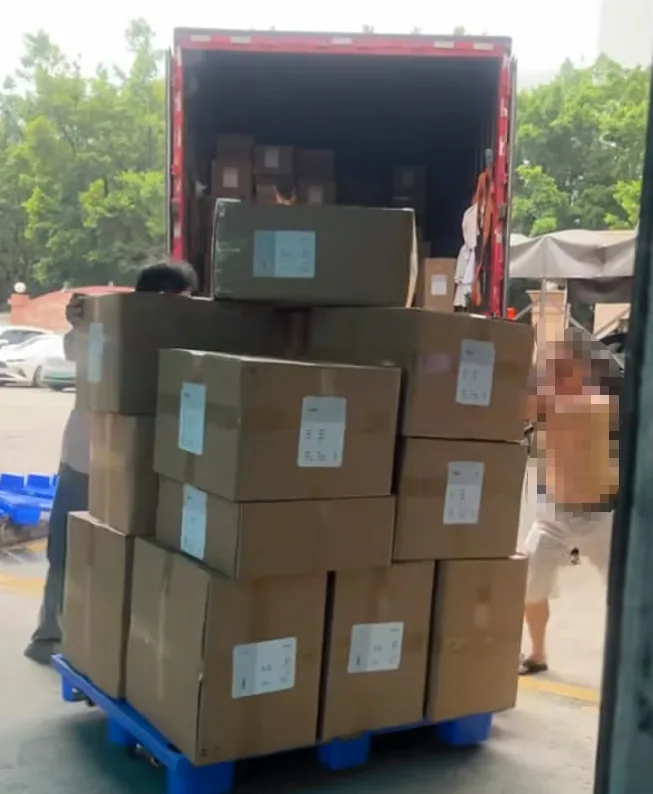
Garments are packed piece by piece to your requirement — folding method, polybag, size ratio and carton marks all follow the packing instruction in the order file — then bundled into woven bags or export cartons and photographed before dispatch, so you see the container going out with your order in it.
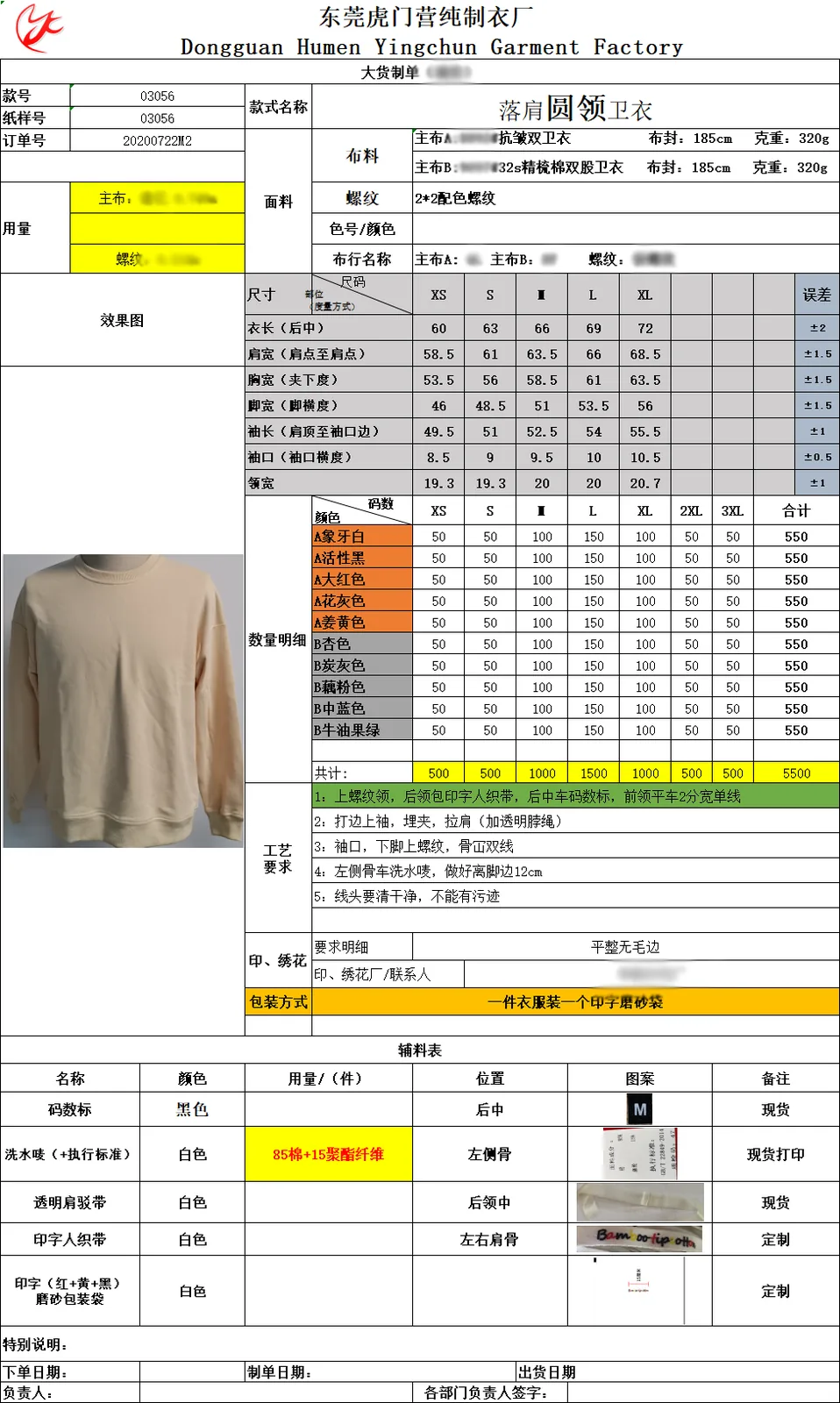
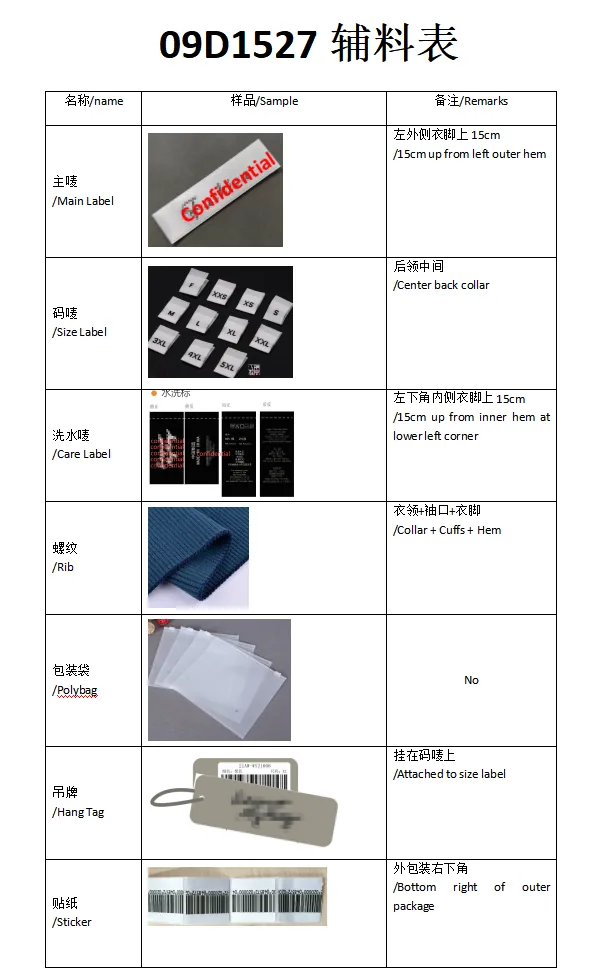
Every order, every style, gets its own production manual — and nothing in it is optional. It travels from sampling through cutting, printing, sewing and finishing to final packing.
When a question comes up mid-production — which rib, which label position, which thread colour — the answer is in the manual, not in someone’s recollection. You can ask to see your order’s manual at any point and we will send photos of it in use on the floor.
Decoration happens at the cut-piece stage (step 05), so every method below is applied to a flat panel against a template taken from your confirmed pattern — not positioned by eye on a finished garment.
| Method | Best for | What we control |
|---|---|---|
| Screen print — plastisol | Bold, opaque graphics on dark fabrics, at volume | Pantone-matched strike-off, cure profile set per fabric |
| Screen print — water-based / discharge | Soft-hand, breathable prints; vintage look on darks | Ink system selection and cure; discharge only on high-cotton |
| Puff print | Raised, tactile streetwear logos | Additive ratio and cure temperature — under-cured flattens, over-cured cracks |
| DTG | Photographic and full-colour artwork, small runs | Pretreatment and cure on smooth, high-cotton fabric |
| DTF transfer | Small runs and many-colour designs, works on blends | Transfer temperature and pressure, recorded per run |
| Sublimation | All-over prints — poly-rich fabrics only | Paper profile, press temperature, panel distortion control |
| Embroidery — flat and 3D puff | Chest logos, sleeve marks, patches | Stitch count, backing and stabiliser so a light jersey does not pucker |
| Heat transfer — names and numbers | Teamwear where every piece differs | Per-piece variable artwork, no plate costs |
Private label trim package. Woven neck labels, printed care labels, size labels, hang tags, custom polybags and printed cartons — all matched and signed off at step 03, so bulk carries exactly the trims you approved. Inside-neck printing instead of a woven label is also available.
Not when it is cured to a tested profile and tested on the decorated panel. We run wash, rub and stretch tests before bulk starts, and we can send the test record with your shipment.
| Semi-custom (stock blanks) | Full custom | |
|---|---|---|
| MOQ | 50 pcs per style per colour | 220 pcs per style per colour |
| Starting point | Our stock solid-colour T-shirt | Your design, sample garment or tech pack |
| Fabric | Stock fabric from our colour card | Sourced or developed to your spec, lab-dipped to Pantone |
| Fit and trims | Our block, your branding | Your fit, labels, hang tags and packaging |
| Sampling | 3–7 working days | 3–7 working days |
| Bulk | 15–25 days after approval and deposit | 15–25 days after approval and deposit |
Shipping. We are in Humen, Dongguan — about 40 minutes from Shenzhen. Sea freight leaves Yantian or Shekou, air and express for samples and repeat orders, and we can quote DDP through our forwarders so you can compare it against your own.
Quality is checked at five points, not one. The sealed sample from step 03 sits on the inspection table throughout — bulk is judged against a physical garment, not against a description.
| Stage | What is checked |
|---|---|
| Incoming fabric | Weight against spec, rejected outside ±5%; shade checked roll by roll under D65; surface defects |
| Cutting | Panel accuracy against the marker; bundle and size tickets |
| In-line, during sewing | Stitch density, seam allowance, neck rib tension, hem and side-seam construction |
| Finishing | Loose threads trimmed, stain check, steam pressing, measurement against the size spec |
| Final inspection | AQL 2.5 sampling for major defects, measured against the sealed sample |
Any deviation outside the agreed tolerances is remade at our cost. That is the whole reason we make two samples at step 03 and keep one sealed: it settles in advance what “matching the sample” actually means.
Our quality system is documented to ISO 9001. Audit requirements differ by retailer and by market, so we would rather be straight with you than print logos: tell us at quotation stage which certification your programme needs — BSCI, SMETA/SEDEX, WRAP, GRS, or OEKO-TEX Standard 100 on the fabric — and we will confirm in writing what we hold, what we can supply from certified mills, and what would have to be arranged before you commit.
It is the first question experienced buyers ask, and it should be. A trading company can quote quickly, but it cannot change a sewing line: when something goes wrong mid-run, the person you are talking to has to phone somebody else. Here is how to check us — and how to check anyone else.
The same test works on any supplier: ask for a live video walk-through at a time you choose, ask which operations run in-house and which are subcontracted, and ask what happens if bulk misses the sample. Vague answers to those three questions cost more than any difference in unit price.
50 pieces per style per colour for semi-custom work on our stock blanks, and 220 pieces per style per colour for a full custom build from your own fabric, colour and fit. Sizes can be mixed within a style; styles cannot be combined to reach the minimum.
A factory. 18,000+ m² across Dongguan and Hunan, four production lines, 180+ workers, knitting and cut-and-sew under our own management since 2009. You can walk the floor in person or by live video.
We quote per style once fabric and decoration are fixed, and the quote itemises fabric, trims, making-up, packing and freight separately. Incoterms we work on: EXW, FOB Shenzhen or Yantian, and DDP door-to-door on request. Price drivers are yarn and GSM, decoration, quantity, colourways and packing spec.
3–7 working days for a sample from confirmed design, and 15–25 days for bulk after sample approval and deposit, depending on quantity and decoration. The exact dates are written into your quote.
Yes — sampling is the normal way to start. The sample charge is quoted per style before we begin and is stated in your quote; sampling takes 3–7 working days and normally covers two rounds, the silhouette and construction first, then neck rib, hem depth, label placement and decoration. A second physical sample stays with us as the sealed standard your bulk is inspected against.
Standard terms are a deposit with the order and the balance before shipment, by T/T; L/C at sight is available for container-volume orders. Your quote states the exact split and terms before you commit.
Five checkpoints: incoming fabric, cutting, in-line during sewing, finishing, then a final inspection to AQL 2.5 for major defects. The sealed sample from step 03 is the reference. Anything outside the agreed tolerances is remade at our cost.
Our quality system is documented to ISO 9001. Rather than print logos we may not be able to back up, tell us which certification your retail client requires and we will confirm in writing what we hold, what we can supply from certified mills, and what would need arranging — before you place an order.
All of it, in one order: fabric sourcing or development, woven neck labels, printed care and size labels, hang tags, inside-neck printing, screen print in all ink systems, DTG, DTF, sublimation on poly, embroidery, heat transfer, plus custom polybags and printed cartons. Trims are matched and signed off before bulk.
Both. We will do a live video walk-through of cutting, printing, sewing and finishing on WhatsApp at a time you choose, or you can visit us in Humen, Dongguan — about 40 minutes from Shenzhen. We will send our business licence on request, and photographs of your own order’s production manual in use on the floor.
220–260 GSM is what the market calls heavyweight on a tee: dense enough to hold an oversized or boxy silhouette. 180–200 GSM is the standard retail weight most brands sell; 140–160 GSM suits hot climates and drapey fashion fits. The same GSM feels different across yarn counts, so ask for swatches at two weights.
Carded open-end is the economical yarn — a slightly fuzzier surface, fine for promotional tees. Ring-spun adds a spinning step that gives a finer, more even yarn. Combed ring-spun adds a further combing step that removes short fibres, giving the softest hand and the cleanest print surface, at a moderate premium. For tees that carry detailed prints, we recommend combed ring-spun.
Screen printing is the most cost-effective above roughly 100 pieces per design; each extra colour adds a screen, so one- and two-colour art prices best. DTG prints unlimited colours directly into the fabric — best for small runs and photographic art on high-cotton tees. DTF transfer handles many-colour designs on blends at small scale. Tell us the design and quantity and we will price two methods side by side.
Side-seamed as standard — the body is cut flat and joined with two side seams, which controls the silhouette and stops the fabric twisting in the wash. Tubular bodies, knitted as a seamless tube, are available on request where unit cost matters more than fit. Your tech pack states which one is being quoted.
Some movement is physics on any cotton knit, but it is planned for, not discovered later: every fabric lot is wash-tested before approval, the measured shrinkage is built into the pattern as an allowance, and the bulk cloth is steam pre-shrunk before cutting. Your size chart describes the garment after washing — which is the measurement your customers will actually take.
Trial orders are the normal way to start — from 50 pieces on stock blanks. We ship FOB Shenzhen or Yantian as standard and can quote DDP door-to-door through our forwarders for the US, UK and EU, with the freight leg quoted separately so you can compare it with your own forwarder.
Send us a sketch, a reference tee or a spec and we will come back with fabric options, a costed build-up and a sampling date. If you would rather see the floor first, book a visit — we are 40 minutes from Shenzhen.
Request a Quote Book a Factory Visit WhatsApp +86 158 7649 3800Related: T-shirts catalogue · Hoodie manufacturer · Polo shirt manufacturer · Joggers & sweatpants · Book a factory visit · About our facilities
SLSPOLO · custom T-shirt manufacturer, Humen, Dongguan, Guangdong, China · Request a quote · Last updated 17 October 2026